The problem
Creators sit on hours of long-form video but lack the time to cut it into platform-ready shorts. The naive solution, “just use an LLM to write captions,” fails because it ignores the creator’s actual editorial taste. A creator’s voice isn’t a prompt; it’s a pattern of decisions made while editing. The real problem is building a pipeline that both produces content and learns the creator’s preferences from their behavior.
What I built
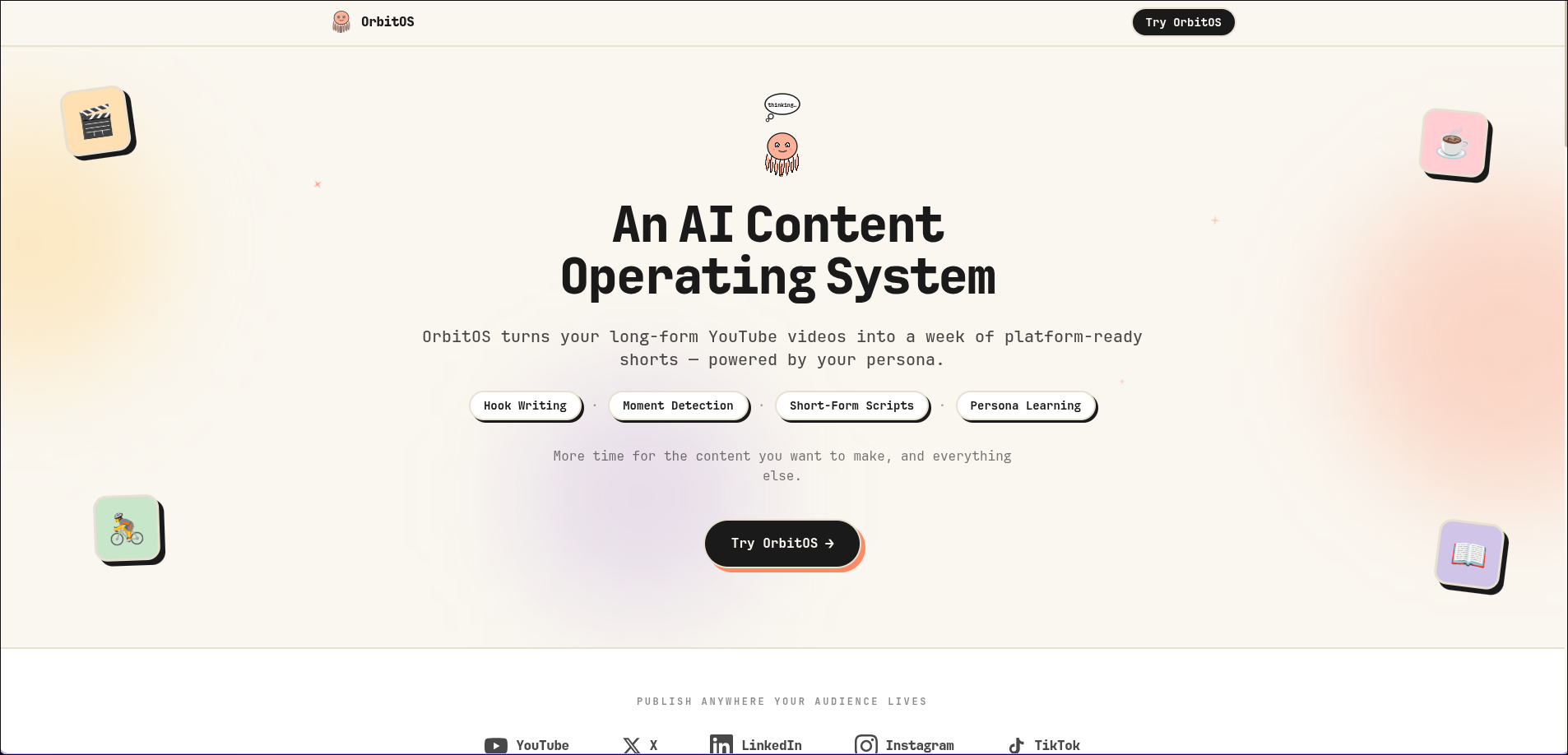
OrbitOS is an AI-native creator pipeline. Feed it a YouTube video, and it produces a week of platform-ready shorts, each with a hook, captions, and a cut, while a behavioral memory loop learns your editorial voice from how you approve, reject, and edit the output.
How it works
- Ingest. Pull a long-form video via
yt-dlp. - Transcribe & segment. Transcribe with Whisper and identify candidate moments.
- Clip extraction. Keyframe-aware
ffmpegcutting that respects scene boundaries, not arbitrary timestamps. - Structured generation. An LLM produces structured output (via tool-use) for hooks, captions, and metadata.
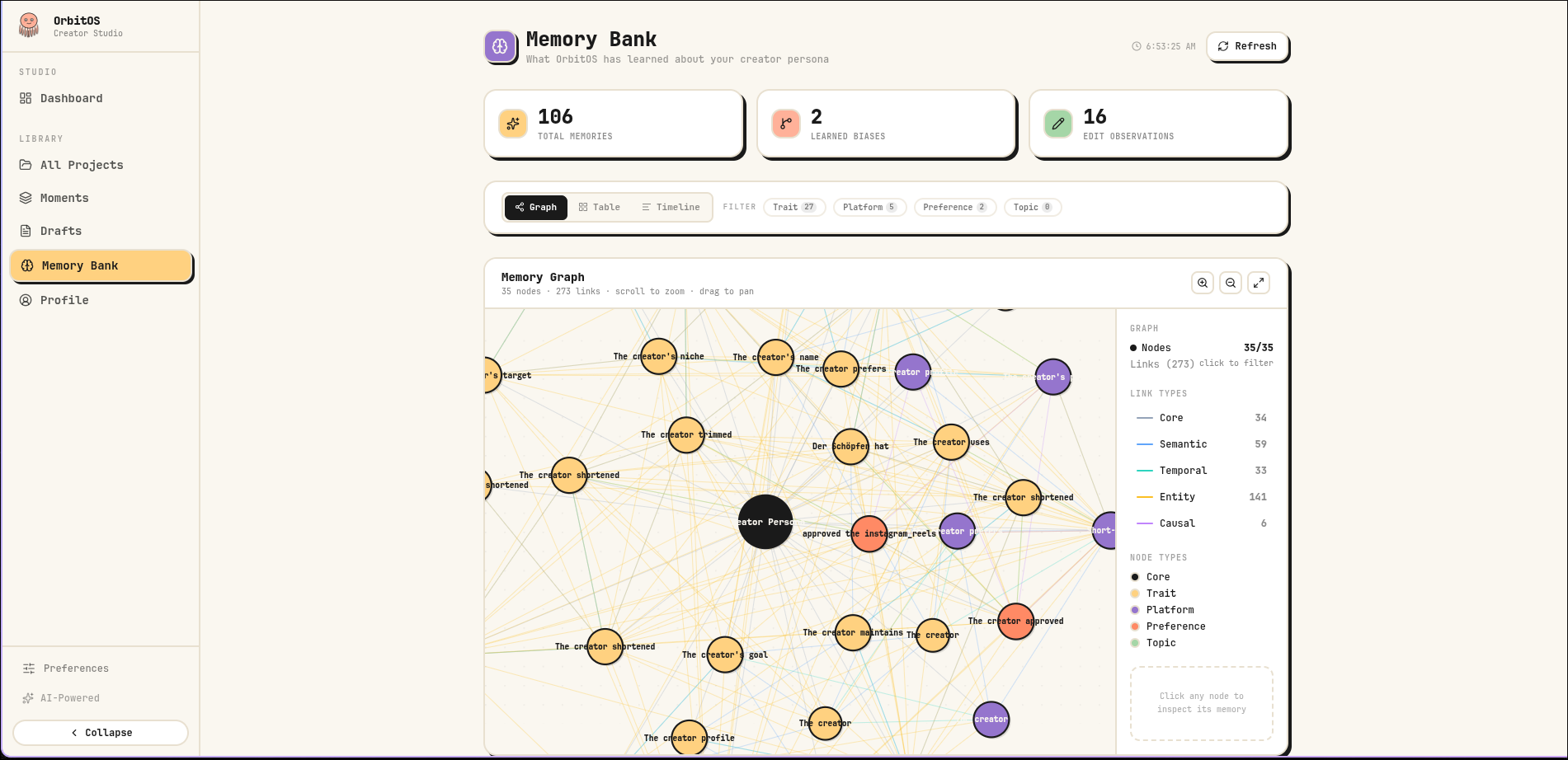
- Memory loop. Your edits and approvals become supervision signals that update a behavioral memory of your voice.
- Cost routing. CascadeFlow routes each step to the cheapest model that meets the quality bar.
Technical decisions
- Behavioral memory loop (review-as-supervision). The system doesn’t ask you to describe your style; it infers it from how you edit. Each approval or rejection is a training signal that refines the memory. This is the differentiator. It learns your voice, not a generic “creator” voice.
- Structured LLM output via tool-use. Instead of parsing free-form JSON, the model emits structured tool calls, which is far more reliable for downstream automation.
- Keyframe-aware clip extraction. Naive timestamp cutting produces jarring cuts. The pipeline detects scene boundaries and cuts on them.
- CascadeFlow cost routing. Not every step needs a frontier model. The pipeline routes cheap steps to cheap models and reserves expensive models for the steps that matter, controlling cost at scale.
Key capabilities
- End-to-end video → shorts pipeline
- Behavioral memory that learns from editing behavior
- Structured LLM output via tool-use
- Keyframe-aware
ffmpegclip extraction - CascadeFlow cost routing across models
- Live deployment
Honest limits
This is a creator tool, not a fully autonomous system. The memory loop improves with use but starts generic. The quality of the shorts depends heavily on the source video and the model routing. It’s a working product with a live deployment, but the “learns your voice” claim is best understood as progressive personalization, not instant cloning.